
Own a U.S. franchise as a non-U.S. citizen
E-2, EB-5, L-1 or green card: what each path needs, how a franchise fits it, and how to fund it. Then talk it through with a consultant, free.
Which path fits you?
Most international franchise buyers use the E-2 visa. Pick the one closest to your situation.
E-2 treaty investor
For citizens of about 80 treaty countries who invest a substantial amount in a U.S. business they own and run. Renewable in 2-year increments, and your spouse can work.
Read more →Leads to a green cardEB-5 investor
Needs a much larger investment ($800,000 in a targeted employment area, $1,050,000 elsewhere) and 10 full-time U.S. jobs. It suits multi-unit or larger deals more than a single unit.
Read more →You already run a company abroadL-1 manager or executive
Lets an owner or manager of a business outside the U.S. open a related U.S. office, such as a franchise unit owned by the same company.
Read more →You already live hereGreen card holder
You can buy like a citizen in most ways. The big difference is financing: SBA loans now require U.S. citizen or national owners.
Read more →The E-2 treaty investor visa
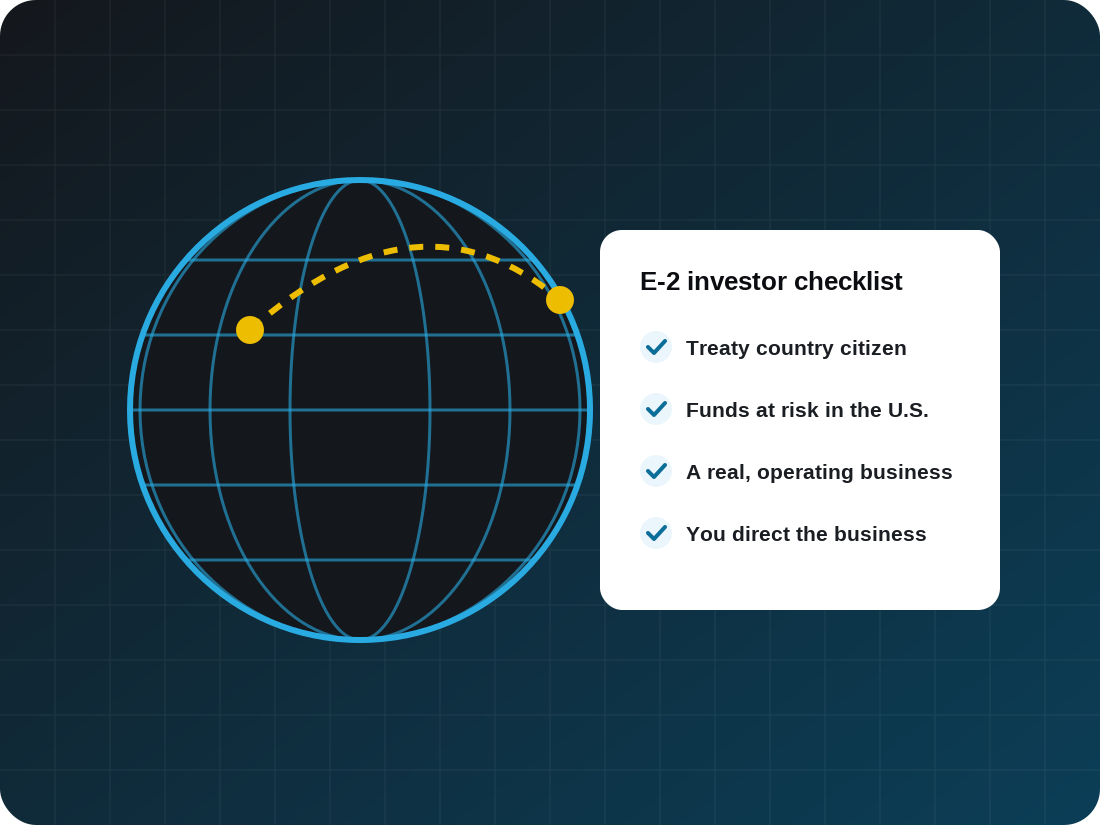
If you are a citizen of an E-2 treaty country, you can buy and run a U.S. franchise on an E-2 visa. You must invest a substantial amount, own at least half of the business and actively direct it, and the business must support more than just your household.
- Treaty country. About 80 countries qualify, including the U.K., Canada, Mexico, Japan, Germany and Colombia. India and mainland China do not. Check the State Department list.
- Substantial investment. No legal minimum, but it must be large compared with the total cost of the business. Under about $100,000 is hard to approve.
- Not marginal. The business should create jobs, usually W-2 employees outside your family, within a few years.
- Ownership and control. At least 50% ownership, or operational control as the manager. Passive investments don't qualify.
- Funds at risk. Money must be spent or irrevocably committed. Escrow that releases on visa approval can work.
- Status and family. Granted in 2-year increments and renewable. Your spouse can work, and your children can attend school.
How a franchise fits E-2
A franchise gives the consular officer a proven model, an FDD with real cost data, and training that shows you can run it. Choose a staffed model, keep your total investment clearly substantial, and make sure the franchisor will sign a conditional or escrowed agreement.
The E-2 franchise timeline
- Check your eligibilityConfirm your country has an E-2 treaty and talk to an immigration attorney before you sign anything.
- Pick a franchise that fits E-2Look for a staffed model you will actively run, with a total investment that is substantial for that business.
- Review the FDD and signYour attorney reviews the franchise agreement. Many buyers make it conditional on the visa.
- Commit your fundsPay the franchise fee and startup costs, or place funds in escrow that releases when the visa is approved.
- Business plan and applicationA 5-year plan showing jobs and growth, plus proof of where your money came from.
- Consulate interview, then openAfter approval you enter the U.S., finish training and open. Status renews in 2-year increments.
EB-5: investing for a green card
EB-5 requires $800,000 in a targeted employment area or $1,050,000 elsewhere, plus 10 full-time U.S. jobs per investor. A single franchise unit rarely creates 10 jobs, so EB-5 buyers usually look at multi-unit or larger formats. Some investors start on E-2 and move to EB-5 later.
L-1: expanding your existing business
If you own or manage a company outside the U.S. and have worked there for at least one year in the last three, that company can open a U.S. franchise unit and transfer you to run it. New-office L-1 status starts at one year.
Green card holders
You can buy like a citizen in most ways, but financing has changed. Since March 1, 2026, SBA loans require every owner to be a U.S. citizen or national (source), so plan on cash, home equity, a non-SBA lender, or a 401(k) rollover (ROBS) if you have U.S. retirement savings.
Funding for international buyers: without SBA loans, most buyers combine their own capital with conventional or home-country financing. Your consultant can introduce lenders who work with non-citizens.
Brands in the usual E-2 range
486 brands in our library list a total investment of $100,000 or more. A starting point to discuss with your consultant and attorney, not a guarantee of approval.
 Great ClipsHealth, beauty & fitness · Total investment $188K–$420K
 Anytime FitnessHealth, beauty & fitness · Total investment $539K–$905K
 Anago Cleaning SystemsCleaning & facility services · Total investment $219K–$339K
 Sport ClipsHealth, beauty & fitness · Total investment $227K–$580K
 Budget BlindsHome services · Total investment $100K–$211K
 Orangetheory FitnessHealth, beauty & fitness · Total investment $765K–$1.1M
 Mathnasium Center Learning LLCKids & education · Total investment $113K–$150K
 HomeVestors of America / We Buy Ugly HousesB2B services · Total investment $108K–$477K
 Express Employment ProfessionalsB2B services · Total investment $132K–$213K
 Batteries PlusRetail & entertainment · Total investment $285K–$537K
 Pet Supplies PlusPets · Total investment $520K–$1.8M
 MeinekeAutomotive · Total investment $225K–$1.2M
 FASTSIGNSB2B services · Total investment $231K–$386K
 SignaramaB2B services · Total investment $245K–$345K
 Lawn DoctorHome services · Total investment $133K–$149K
 Comfort KeepersSenior care · Total investment $120K–$191K
 Hand & Stone Massage & Facial SpaHealth, beauty & fitness · Total investment $321K–$865K
 Smash My TrashCleaning & facility services · Total investment $372K–$492K
 FS Cut & Color f/k/a Fantastic SamsHealth, beauty & fitness · Total investment $172K–$462K
 Big O Tires, LLCAutomotive · Total investment $544K–$2.7M
 One Hour Heating & Air ConditioningHome services · Total investment $143K–$287K
 Precision Tune Auto CareAutomotive · Total investment $127K–$253K
 PuroCleanHome services · Total investment $109K–$153K
 Molly MaidCleaning & facility services · Total investment $144K–$204K
The international buyer track
A step-by-step E-2 checklist, what goes in an E-2 business plan, how escrow works with a franchise agreement, and recorded sessions with immigration attorneys.
Questions international buyers ask
Can I buy a franchise in the U.S. if I am not a U.S. citizen?
Yes. Franchisors sell to non-citizens every day. What matters is your visa path: most international buyers use the E-2 treaty investor visa, and some use EB-5 or L-1.
How much do I need to invest for an E-2 visa?
There is no legal minimum. The investment must be substantial compared with the total cost of the business. In practice, under about $100,000 is hard to approve, and $100,000 to $150,000 or more is typical for small businesses.
Does a franchise fee count toward my E-2 investment?
Yes. The franchise fee, build-out, equipment, inventory and opening costs you have committed all count. Cash sitting in a bank account does not.
Can I get an SBA loan as a non-citizen?
Not any more. Since March 1, 2026, SBA 7(a) and 504 loans require every owner to be a U.S. citizen or national, which excludes green card holders and visa holders (source). Most international buyers fund with their own capital, home-country financing or non-SBA lenders.
Which franchises are best for E-2 investors?
Staffed businesses you will actively manage, with an investment that clearly supports more than your own household. Home-based solo models are harder to approve. See brands in the E-2 range.
Do you work with immigration attorneys?
Yes. We introduce clients to immigration attorneys who know franchising, and we coordinate the franchise side with them.
General information, not legal, immigration or financial advice. Rules change, so confirm your situation with a licensed immigration attorney and your lender. This site is not an offer to sell a franchise; an offer can only be made through a Franchise Disclosure Document.